
Welcome back to this week’s P | A | C | T news, your newsletter by Tech Talent North.
AI conversations have moved past curiosity. For most People & Culture leaders, the question is no longer whether AI will impact HR because it already has. Now, the real question is where it adds value, where it introduces risk and how to implement it without losing the human core of the work.
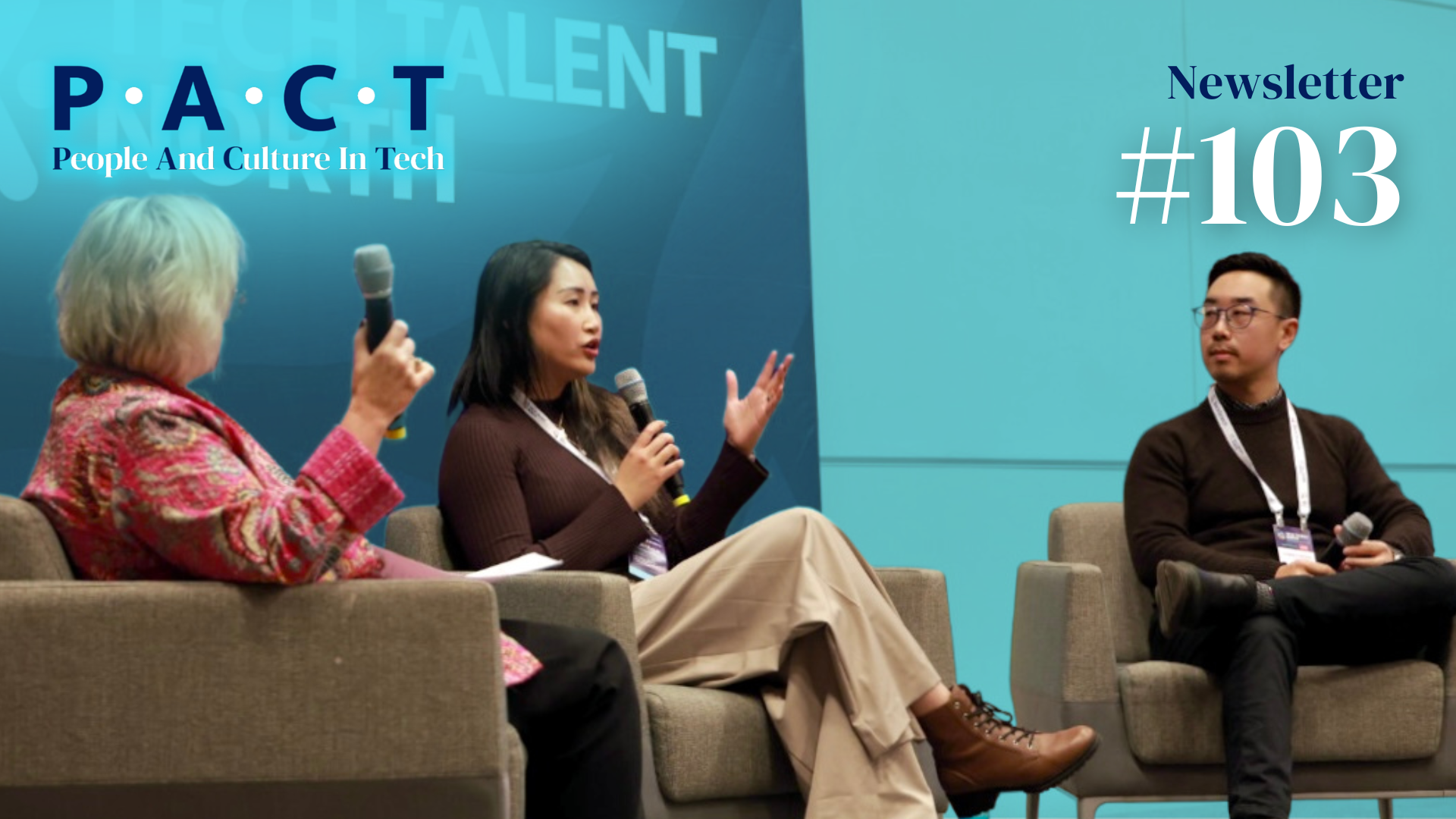
At Tech Talent North Western Edition, Laurie Murdoch, Senior VP, People & Operations at Sony Pictures Imageworks, moderated a practical conversation with Wendy Pat Fong, Senior PM for HR Digital Employee Experience at Microsoft and Advisor at Topicflow, and Christopher Yeh, Director of People Strategy & Execution at Clio.
Their session, Beyond the Hype: Leveraging AI for Practical Performance Results, focused on real use cases, hard decisions, and the guardrails HR leaders must establish as AI becomes embedded into everyday work.
Key takeaways:
- Start with the problem, not the platform.
- Keep a human in the loop when decisions affect people.
- Reimagine HR processes, don’t just automate them.

Where AI Is Already Making A Difference
When Laurie asked where AI is having the greatest impact across the employee lifecycle, Christopher was clear.
AI is touching nearly every stage, but three areas stand out: recruitment, HR service delivery and Learning & Development.
On the recruitment side, the experimentation is moving quickly.
From optimising job postings to reduce bias, to interview intelligence tools that help calibrate hiring decisions, organisations are beginning to reduce manual lift while protecting quality.
In HR service delivery, the gains are measurable. At Clio, AI-powered tools have already driven a 15–20% deflection rate in HR queries, freeing up capacity for more complex employee needs. That means fewer repetitive ticket responses and more time spent where human expertise actually matters.
In Learning & Development, AI is accelerating content creation. Christopher noted that learning designers can now generate and iterate content far more efficiently, making it easier to keep pace in fast-moving industries.
Wendy echoed this from the Microsoft perspective, while cautioning against stopping at surface-level automation.
“But you really need to start thinking about how do you want to reimagine HR at your company?”
AI layered on top of siloed processes simply scales those silos. The opportunity lies in stepping back and asking what HR could look like if redesigned with today’s capabilities in mind.

The Human-In-The-Loop Principle
As organisations move from automation toward more agentic AI systems, the ethical line becomes clearer.
Wendy shared how Microsoft draws a distinction around decision-making authority:
“…one of the big things that we make a distinction on is can an AI solution make a decision on your behalf? So that’s one of a cut point for us…”
If an AI tool is simply surfacing information or supporting insight, the risk profile is different. If it is making a decision that affects someone’s job, compensation or opportunity, the scrutiny must increase.
Christopher reinforced this point, especially in recruitment. Delegating hiring decisions entirely to AI may seem efficient but it removes necessary discernment and accountability.
The message remained consistent: AI can support judgement but It should not replace it.
Build vs. Buy: A Strategic Pause
One of the most practical insights from the session came from Christopher’s reflection on Clio’s near-decision to build an internal AI tool early on.
“I’m really glad we didn’t make that choice because the amount of energy, time and resourcing, we would’ve had to just keep up with the pace of change across all these vendors would’ve cost us so much more.”
The pace of AI development means maintaining in-house tools can become resource-intensive quickly. For many HR teams, the smarter move is to assess what problem needs solving, evaluate vendor maturity and consider data readiness before committing to build.
Wendy added another important lens: ROI should not be measured purely on adoption.
“A lot of people started to be like, well, we are going to count adoption as how many people are using it. That’s not how it works.”
Usage metrics do not equal value. The right question is whether the tool solves a meaningful business challenge.

Resistance, Fear & The Skills Shift
No AI implementation conversation is complete without addressing employee resistance.
Christopher highlighted two primary sources: time constraints and fear of job displacement. The second often dominates headlines, but in practice, the larger barrier can be bandwidth and uncertainty.
Wendy offered a reframing grounded in practical skills evolution.
“Instead of an employee reading it, can AI read it? So it’s still the same job, but you are learning new skills and adding that AI component to it.”
The nature of work is shifting, not disappearing. Content writers now think about structuring information for both humans and AI systems. HR professionals must understand prompts, workflows and data structure alongside traditional policy writing.
Reskilling cannot be left to employees to figure out on their own. Wendy described Microsoft’s use of cross-functional hackathons, where non-technical teams experiment hands-on with AI tools in real work scenarios.
Exposure reduces fear and participation builds confidence.
What This Means For People & Culture Leaders
The panel’s discussion pointed to three imperatives for HR leaders navigating 2026:
- Define your AI narrative clearly because efficiency alone is not a compelling reason. Instead, articulate how AI supports growth, capability and employee experience.
- Establish guardrails early and decide where AI can assist and where human judgement remains essential.
- Invest in skills evolution, to create space for teams to experiment, learn and build familiarity without penalty.
Wendy captured the broader significance of this moment:
“I’m excited for the new frontier that we are going through. AI is like when we first had the internet or a mobile app… I think it’s a big moment.”
AI in HR is no longer experimental, it’s operational, and the leaders who approach it with clarity, discipline and a human-centered lens will shape how their organisations perform in the years ahead.