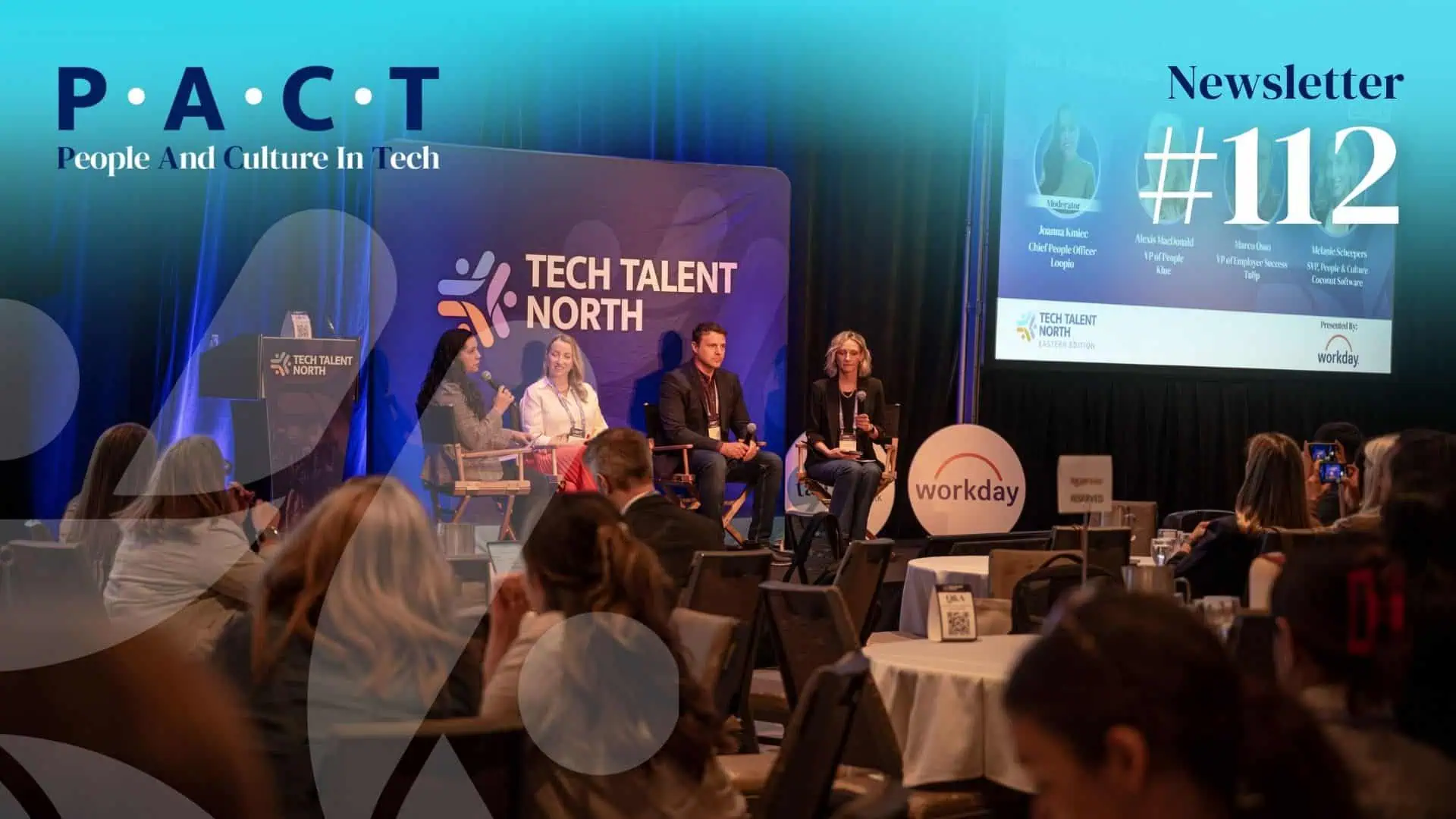

Welcome back to this week’s P | A | C | T news, your newsletter by Tech Talent North.
Many of the conversations at Tech Talent North, Eastern Edition centered around a challenge that doesn’t have a straightforward answer.
AI is reshaping work. Expectations continue to rise. Teams are being asked to move faster while leaders are making decisions without a clear view of what their organizations may look like several years from now.
Across discussions on leadership, workforce planning and organizational design, one theme emerged repeatedly: the future remains uncertain, but leadership cannot wait for certainty to arrive.
Key takeaways:
- Many of the assumptions that shaped leadership and workforce decisions in the past are being challenged.
- Workforce planning is increasingly becoming a conversation about redesigning work, not simply forecasting headcount.
- The leaders who thrive in uncertainty will be those who build trust, encourage adaptability and help others move forward without having all the answers.

Rethinking What We Assume To Be True
Opening keynote speaker Fahd Alhattab challenged attendees to examine the beliefs they may be carrying into a rapidly changing environment.
“It’s not what you don’t know that stops your success. It’s what you do know that is no longer true.”
The observation resonated because it extended far beyond AI.
Stephanie Hollingshead from TAP Network shared findings from a study of 84 Canadian technology companies, which revealed that the highest-performing organizations generated significantly greater employee lifetime value while operating with leaner teams.
Retention rates above 80 per cent produced disproportionately stronger outcomes, while engagement emerged as a measurable contributor to business performance.
The conversations throughout the day suggested that organizations may need to rethink what effectiveness looks like. Growth is no longer measured solely through expansion. Increasingly, leaders are being asked to focus on capability, retention and the conditions that allow people to do their best work.
Planning For Work That Is Still Taking Shape
Questions about uncertainty surfaced again during discussions on AI and workforce strategy.
Lisa Highfield acknowledged something that prompted knowing laughter from the audience.
“I don’t know that anybody felt like they were doing a good job with workforce planning in the first place.”
Organizations want forecasts, boards want plans and finance teams want predictability.
At the same time, leaders are trying to understand how emerging technologies will influence roles, workflows and the skills required to succeed.
Mark Grimwood from Salesforce argued that adding AI to existing processes is not the same as redesigning work.
“People aren’t afraid of AI. People are afraid of being left behind.”
The distinction matters.
Employees are often less concerned about technology itself than they are about relevance, opportunity and whether they will be supported as expectations evolve.
People leaders sit at the center of that transition. They are increasingly being asked to balance experimentation with stability while helping organizations understand where technology creates value and where human judgment remains essential.
As those conversations move into executive and board settings, the ability to connect workforce decisions to broader business outcomes becomes increasingly important.
Talent discussions are no longer separate from discussions about growth, productivity and long-term performance.

Leadership That Creates More Leaders
If the future remains uncertain, the leadership approach required to navigate it may also need to evolve.
Phil Jewell challenged attendees to consider a simple but powerful question:
“How well would the team you lead keep moving forward when you are not there?”
Many leaders want empowered teams, yet unintentionally position themselves as the answer to every problem. The desire to be helpful can gradually turn leaders into bottlenecks.
Phil argued that leadership is less about being indispensable and more about creating environments where others can step forward confidently.
Trust, delegation and psychological safety are often discussed as cultural aspirations.
Increasingly, they are operational necessities.
Organizations facing constant change need teams capable of exercising judgment, making decisions and adapting quickly without waiting for certainty to emerge.
A Final Thought
The assumptions that built successful organizations over the past decade are being tested.
Work is changing, technology is evolving and employee expectations continue to shift.
Perhaps that is why spaces like Tech Talent North matter.
Not because anyone arrives with all the answers, but because they create opportunities for People leaders to challenge assumptions, exchange experiences and learn from others navigating similar pressures.
Many of the most valuable moments at TTNE happened beyond the stage, through candid conversations about what worked, what failed and what leaders are still trying to figure out.
These reflections represent only a handful of the ideas explored throughout the day.
From early morning workshops and breakout sessions to keynote presentations, panel discussions and conversations across the exhibit floor, speakers, sponsors and attendees each contributed to a shared understanding of what leadership requires in a time of ongoing change.
The leaders who thrive in this next chapter may not be those who predict the future most accurately but those willing to keep learning and help others navigate uncertainty with confidence.
Join 300+ senior People & Culture leaders at Tech Talent North, Western Edition on November 17, 2026 at the Vancouver Convention Centre West.