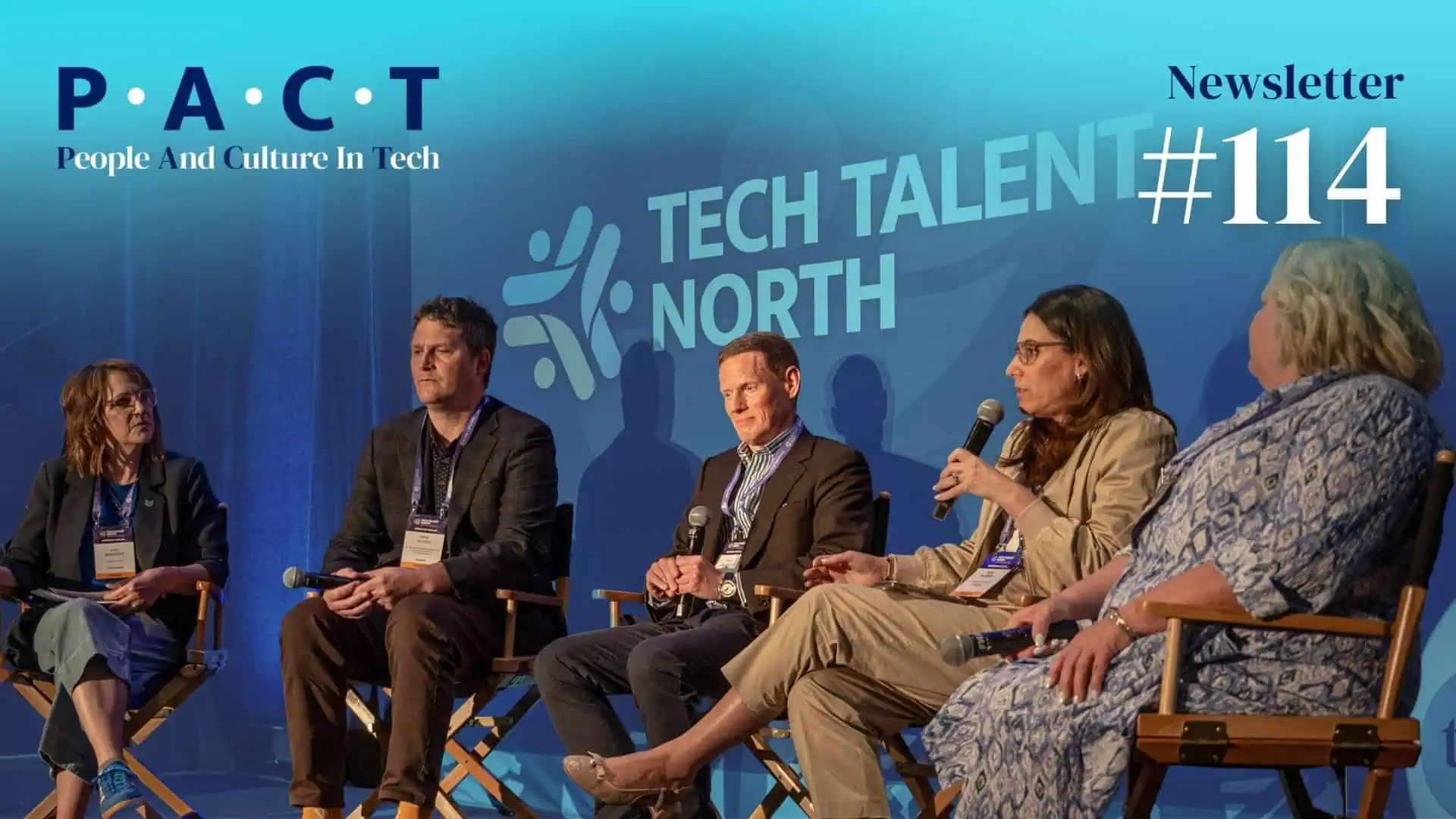

Welcome back to this week’s P | A | C | T news, your newsletter by Tech Talent North.
Workforce planning is changing.
As AI becomes part of everyday work, organizations are looking beyond headcount to rethink how work is designed, where people create the greatest value and what capabilities they’ll need next.
At Tech Talent North, Kim Benedict (TalentMinded) joined Mike Auger (Workday), Paul Callaghan (Winston Taylor), Lisa Highfield (McLean & Company) and Vita Di Serio (Prophix) to explore how AI is reshaping workforce planning, organizational design and leadership decision-making.
Key takeaways:
- Workforce planning is becoming a conversation about workflows as much as headcount.
- AI is exposing long-standing weaknesses in workforce planning rather than creating entirely new ones.
- Organizations making the most progress are pairing technology with governance, trust and thoughtful leadership.

Workforce Planning Starts Before Hiring
One of the strongest themes throughout the discussion was that workforce planning is beginning much earlier than it used to.
Instead of starting with a vacancy or a hiring request, organizations are stepping back to ask whether the work itself should change before another role is added.
Kim Benedict explained that TalentMinded now approaches workforce planning through two connected lenses: building AI fluency across the organization while identifying where workflows can be redesigned before additional headcount is considered.
“As we continue to scale, it’s around responsible scaling. Is it incremental headcount, or is it actually optimizing a workflow?”
That shift changes the role of workforce planning. Rather than forecasting roles first, organizations are increasingly examining how work gets done before deciding where people add the greatest value.
AI Is Revealing What Already Needed Attention
Much of the conversation around AI suggests the technology is driving organizational change.
The panel challenged that assumption.
Kim questioned whether AI is creating workforce planning challenges or simply exposing issues that have existed for years.
“I don’t know if AI is necessarily helping with workforce planning… it might be exposing what already wasn’t working.”
Many organizations were already relying on disconnected planning processes, inconsistent job architecture and limited visibility into future capability needs. AI has simply made those weaknesses harder to ignore.
Lisa Highfield shared McLean & Company’s research showing that while organizations with more mature AI strategies are seeing measurable productivity gains, most remain “stuck in the messy middle,” experimenting with pilots while trying to operationalize AI across the business.
The technology is evolving quickly.
Building the organizational capability to use it well takes considerably longer.
Productivity Has A New Vocabulary
The discussion also explored how organizations are redefining productivity.
For years, workforce planning centered largely on labour costs. Now, AI is broadening that conversation.
Kim introduced a distinction that is increasingly shaping conversations with executive teams.
“We’re now looking at cost avoidance. Are you leveraging technology to avoid cost, or is it cost out?”
Avoiding future costs by redesigning work is not the same as reducing existing costs. Organizations are also beginning to account for new variables, including licensing, compute power and token consumption.
Vita Di Serio shared how Prophix is already applying that thinking. AI is supporting sourcing, onboarding and internal HR workflows, reducing repetitive work so people can spend more time on activities that require judgement, collaboration and human interaction.
Workforce planning is becoming less about labour alone and more about understanding the relationship between people, technology and the work itself.

Technology Doesn’t Replace Judgement
The panel was equally clear about AI’s limitations.
Paul Callaghan cautioned against treating AI as a substitute for expertise, particularly when making employment decisions.
“AI at its best is helping you get better at what you already know.”
AI can strengthen analysis, accelerate research and organize information. Responsibility, however, still sits firmly with people.
“You are liable. You can never say AI told me.”
Mike Auger reinforced that point from the technology perspective. Enterprise adoption has been slower than many expected, not because organizations lack interest, but because workforce planning depends on some of the most sensitive data businesses hold. Before AI can support better decisions, organizations need confidence in their data, governance and guardrails.
As Mike put it, “The data has to get right first.”
Transformation Depends On Trust
Technology was only part of the conversation.
How employees experience that change may ultimately determine whether transformation succeeds.
Paul observed that people are far more likely to embrace AI when they believe it helps them do better work rather than making them feel replaceable.
“Employees are going to work with you if they think you’re going to make their life easier… If it looks like you’re investing in new ways of working that may result in them losing their jobs, you’re going to see an increase in grievances and potential claims.”
Lisa Highfield connected that directly to change management. Research shows organizations see stronger adoption when they invest as much in communication, leadership and capability building as they do in technology. Every organization will have early adopters, skeptics and everyone in between. Helping people navigate that journey is becoming one of HR’s most important responsibilities.
A Final Thought
One idea surfaced repeatedly throughout the discussion.
The conversation around AI is becoming less about the technology itself and more about how organizations design work.
The questions leaders are asking are changing. Workforce planning is no longer simply about forecasting headcount. It is becoming an exercise in understanding where people create the greatest value, how technology supports that work and what capabilities organizations will need next.
The organizations that make the greatest progress won’t necessarily be those adopting AI the fastest. They’ll be the ones using it thoughtfully, investing in the right foundations and bringing their people with them as work continues to evolve.