
Welcome back to this week’s P | A | C | T news, your newsletter by Tech Talent North.
AI is no longer just a digital tool sitting behind a screen.
It’s beginning to enter physical workplaces, taking shape as machines that move, lift, assemble and interact with the real world. For People and Culture leaders, this raises new questions about jobs, skills, trust and what it really means to prepare a workforce for what’s next.
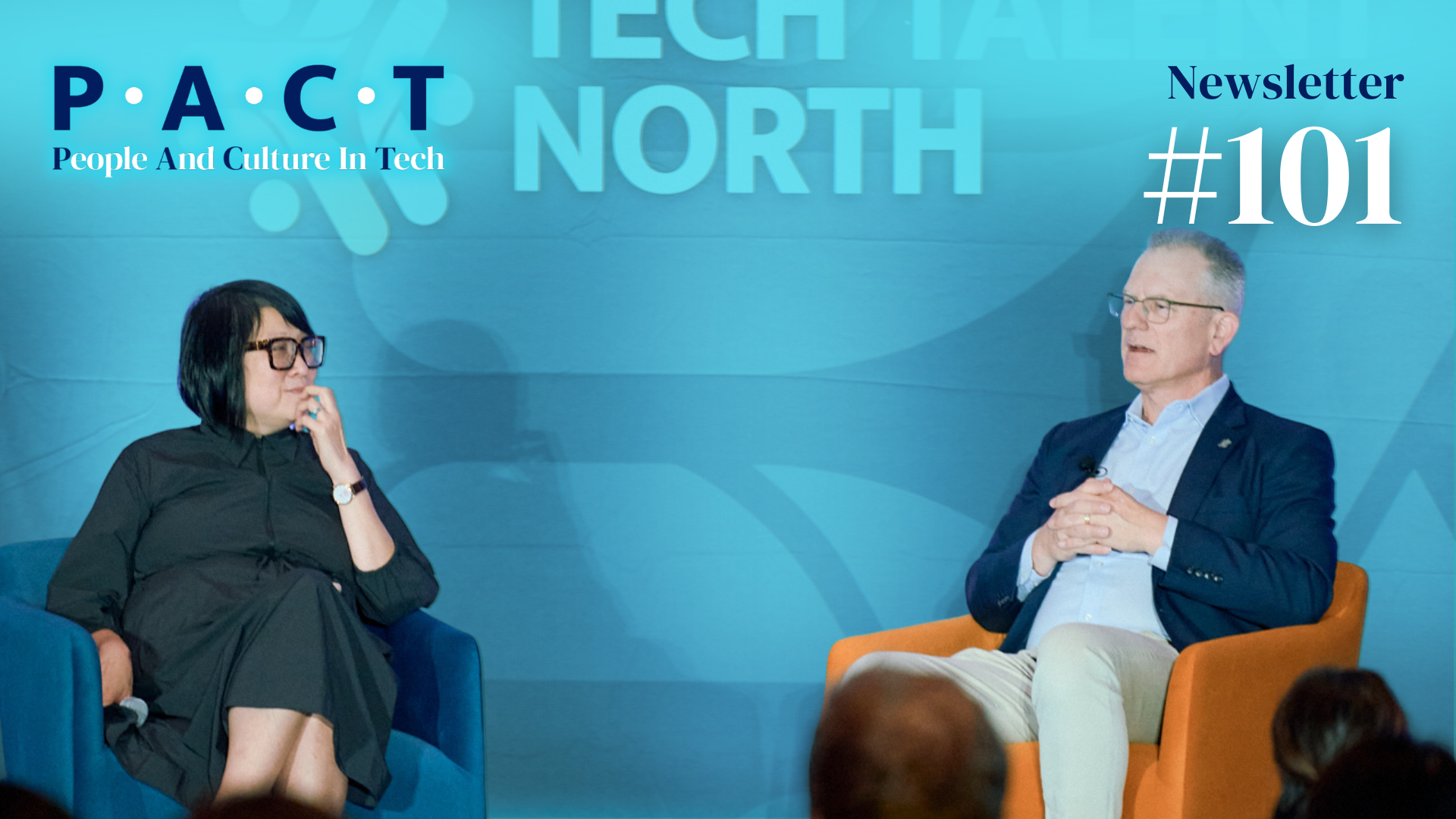
At the Tech Talent North, Western Edition, Lewisa Anciano, Fractional Chief People Officer at Sanctuary AI, and Ben Nyland, Strategic Advisor at Sanctuary AI and former CEO of Loop Energy, offered a grounded, reality-checked look at what an augmented workforce actually means today.
Their session, Humanoids in the Org Chart: Planning for the Augmented Workforce, focused less on science fiction and more on what HR leaders need to understand now.
The message throughout the session was clear: this isn’t about replacing people. It’s about rethinking work.
Key takeaways:
- Focus on tasks, not jobs. Physical AI is being applied to repetitive, unsafe and undesirable work.
- Prepare for job evolution. New roles will emerge alongside automation, especially in oversight, retraining and process design.
- Lead with transparency. Trust and openness determine how teams respond to AI in the workplace.

Why Physical AI Is Different
Ben began by drawing a clear line between digital AI and what Sanctuary AI works on every day.
Digital AI helps process information. Physical AI interacts with the real world.
“We are working with general purpose robots… but there are many tasks in those environments that are repetitive, difficult for people to do, not interesting or dangerous, that haven’t yet been automated because the environment can’t be properly structured.”
For HR leaders, this distinction matters. Much of the public conversation about AI assumes job replacement. What Ben described was far more targeted: automating specific tasks that are hard to staff, unsafe or unsustainable over time.
“And so we’re looking at replacing tasks and not people.” said Ben.
What’s Actually Driving Adoption
Despite headlines about cost-cutting, Ben was clear that the companies Sanctuary works with are not adopting robotics to reduce headcount.
“The companies we’re engaging with… are really struggling to hire people to do the work that needs to be done.”
Demographic shifts across Western countries mean fewer people are entering the workforce just as demand for labour remains high. In some industries, roles simply go unfilled. Physical AI is emerging as a response to that gap, not a shortcut around people.
From an HR perspective, this reframes the conversation. AI adoption becomes a workforce sustainability strategy rather than a cost conversation.

Trust Determines Adoption
One of the most important insights from the session had nothing to do with technology.
Ben shared that in some organizations, employees are open, engaged and even excited to participate in automation discussions. In others, fear dominates.
The difference comes down to trust.
“These companies have established a level of trust with their employees… there’s also a level of transparency. The company is not trying to hide this process.”
Where employees believe leadership is using technology to grow the business and keep people employed, conversations are productive. Where AI is framed as a way to cut costs, employees sense it immediately.
Lewisa reinforced this point, emphasizing co-creation and tone at the top. When employees help identify tasks for automation and understand they’re not training their replacements, resistance drops and innovation increases.
The Reality Check On AI Hype
The session also pushed back on some of the louder narratives surrounding humanoid robots.
“We are not going to have more humanoids than humans by 2030. As someone inside the industry, I can tell you that with absolute certainty.”
Ben introduced the concept of the “data wall,” explaining that training AI to function in the physical world requires exponentially more data than training digital tools like language models.
This matters for HR leaders because it resets expectations. The future will arrive incrementally, not overnight. That creates space to plan, reskill and adapt rather than react.
New Talent Challenges For HR
As automation enters physical environments, new people challenges emerge.
Lewisa noted that Sanctuary AI faces one of the most complex recruiting environments she’s seen, requiring a blend of hardware, software, and machine learning expertise.
Ben added context from the executive side.
“The technical people at Sanctuary are paid higher than anyone else I’ve seen in Vancouver, and yet south of the border they could command two to three times that salary.”
For Canadian HR leaders, this highlights both a challenge and an opportunity. While competition for AI talent is intense, geopolitical shifts and increased focus on Canadian AI sovereignty are helping retain expertise domestically.

Preparing For Job Evolution
One of the most thoughtful moments in the session came when Ben addressed the impact on lower-skilled roles.
“Yes, it is most likely to affect low skilled workers… the robots for the foreseeable future are going to require management by people.”
Rather than ignoring this reality, he urged HR leaders to think early about retraining pathways. Managing, supervising and improving automated systems will create new roles, but only if organizations invest intentionally.
HR’s Role In An Augmented Workforce
When asked about “HR for robots,” Ben’s response was intentionally simple.
“HR for robots is they’re in the closet overnight.”
The humour underscored a serious point: robots are tools, not colleagues. HR’s role is not to humanize machines but to support people through change.
That means helping leaders communicate clearly, involving employees in design decisions, planning for skills evolution and keeping ethics, safety and trust front and centre.
What This Means For People & Culture Leaders
This session offered a grounded roadmap for HR leaders navigating the next phase of AI adoption.
- Frame AI as task support, not workforce replacement
- Involve employees early through transparency and co-creation
- Prepare for new roles tied to oversight, retraining, and system management
- Invest in trust before introducing automation
- Keep expectations realistic and avoid hype-driven decisions
As Lewisa and Ben made clear, the future of work is not humans versus machines. It’s humans supported by machines, doing better work together.”